.svg)


For a long time, GDPR compliance projects have been carried out based on manual management, relying on checklists, spreadsheets, documents, scattered notes, or generic organizational tools.
And that makes sense, lists and spreadsheets are simple, fast, and create a sense of progress.
The reality, however, is that GDPR compliance requirements have evolved year after year. Strategic partners began conducting compliance audits as a prerequisite for closing deals.

Therefore, if your project still depends on manual management, it likely requires more time and effort to reach the level of maturity needed for GDPR compliance. That’s where structured management comes in.
Manual management is the starting point, but structured management is what leads to effective data governance.
What GDPR Requires in Practice
The logic of the law, especially the principle of accountability, described in Article 5, n°2 of the GDPR, is not satisfied merely by completing tasks.
The regulatory authority expects organizations to demonstrate continuous governance, substantiate decisions made, maintain updated records, respond quickly to incidents and data subject requests, and continuously improve their processes over time.
In other words, it’s not enough to do, you must manage, monitor, and prove. And for that, structured management is essential, ensuring organization and security.
Manual Management vs. Structured Management
The difference between these two models is not merely operational, it is what separates execution from governance.
Manual management, carried out through tools such as Excel, Word, and others, may create the illusion of saving resources. In reality, it often leads to rework and the loss of many hours on tasks that automated tools could perform with excellence in just minutes, and time is money.
Additionally, manual management suffers from low traceability, decentralized information, dependence on individual control, and limited scalability. It can work well in the early stages, organizing policies and documents, structuring data inventories, and managing basic tasks.

The problem arises as complexity increases: when consultants handle multiple clients or departments simultaneously, deal with task interdependencies, require continuous data updates, centralize evidence, and monitor risks in real time.
Structured management transforms the process into a continuous, integrated system through tools specifically designed to meet GDPR requirements. These tools ensure centralized data and evidence, full traceability, standardized processes, an integrated project view, and consistent scalability, freeing up time for tasks that truly require human input, such as training and client meetings.
Simply put, manual management solves the present, while structured management sustains the future, ensuring real data governance and higher compliance maturity.
The 4 Maturity Levels in GDPR Projects
GDPR maturity is directly linked to an organization’s ability to govern, sustain, and demonstrate compliance over time.
Based on practical observation, maturity levels can be divided into four stages:
- Level 1: Operational
At this stage, GDPR is treated as a one-off demand. Key characteristics include: predominant use of spreadsheets, documents, and parallel controls; decentralized and poorly integrated information; demand-driven execution without structured planning; low traceability of decisions and changes, strong dependence on specific individuals.
Main risks include loss of critical information, difficulty proving compliance in audits, high likelihood of rework (e.g., corrupted or deleted files), and low data reliability.
The project exists, but there is no governance.
- Level 2: Tactical
At this stage, there is a clear attempt to organize and standardize operations. Characteristics include: creation of templates (policies, inventories, reports); initial structuring of workflows; partial centralization of information; use of generic tools with adaptations; greater predictability in deliverables.
However, limitations remain: Manual controls prone to errors; inconsistent data updates; difficulty scaling across clients or departments; low integration between activities.
There is a method, but it does not yet scale sustainably.

- Level 3: Managerial
This is the turning point. GDPR moves from operational execution to systemic management. Characteristics include: Use of structured GDPR systems or tools; centralization of data, tasks, risks, and evidence; traceability of actions and decisions; effective process standardization; consolidated view of project progress.
At this level, benefits become clear: Significant reduction in rework; greater control and predictability; ability to manage multiple projects simultaneously, improved quality of deliverables.
Operations no longer depend on individual effort, but on integrated technological and technical systems.
- Level 4: Strategic
At this stage, GDPR is fully integrated into the organization’s or firm’s strategy. Characteristics include: Continuous compliance monitoring; use of KPIs and risk metrics; active data lifecycle management; integration with other areas (compliance, legal, IT, security); structured internal audit capabilities.
This level provides competitive advantages and strong governance through: Data-driven decision-making; continuous monitoring; risk anticipation; consistent scalability; transformation of GDPR into a strategic asset.
Here, GDPR does more than protect, it creates value and consistency.
Discover Your Organization’s Maturity Level
ECOMPLY has developed a gap analysis tool capable of mapping your organization’s maturity level in just a few minutes through strategic questions about:
- Governance and accountability;
- Documentation of processing activities;
- Suppliers and partners;
- Data subject rights;
- Data deletion and disposal;
- Processing security;
- Data protection incidents.
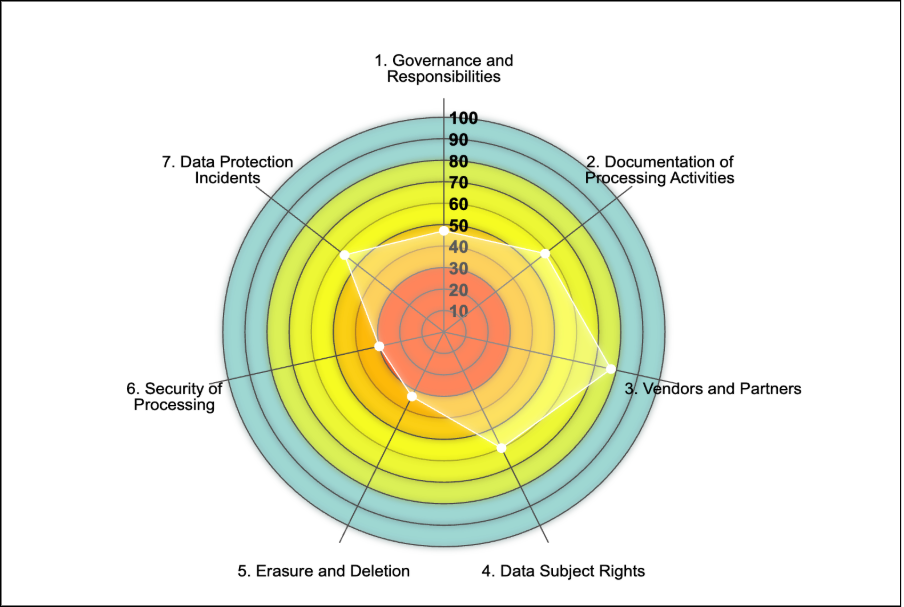
Based on the chart generated by the tool, ECOMPLY highlights the areas that require the most attention in your compliance project, helping you eliminate gaps and achieve results closer to 100%.
Maturity is not just about what has been done, it’s about the ability to keep it alive, updated, and demonstrable. Without structured management, compliance tends to deteriorate over time.
When restructuring compliance areas that were not well developed initially, it is advisable to redo the gap analysis to closely track progress and confirm that the suggested changes have improved project maturity.
Come see how it works in practice and elevate your organization’s maturity level.
The Turning Point
Clear signs that your operation needs to move away from manual management include:
- Managing more than 2 or 3 clients/projects simultaneously;
- Wasting time searching for information;
- Frequently redoing tasks;
- Lack of clear visibility into progress;
- Dependence on memory or personal organization;
- Constantly “putting out fires” instead of building a solid structure.
If this sounds familiar, the issue may lie in your management model.
How to Ensure Excellence in Management
Manual management is an excellent starting point, but staying in this model over time limits efficiency, scalability, and, most importantly, legal security.
Mature GDPR projects are those that can sustain themselves over time and maintain governance under continuous oversight. For that, ECOMPLY can be your strategic ally.
Schedule a demo at any time and discover how we help your project move intuitively and efficiently from Level 1 to Level 4 maturity.
ECOMPLY is a GDPR compliance management software that assists in building and maintaining compliance documentation. Check out our website or contact us for more information.


