.svg)


In the week of International Data Protection Day 2026, we had another reason to celebrate: Brazil and the European Union finally signed the bilateral agreement to adapt the LGPD (Brazilian General Data Protection Law) and the GDPR (General Data Protection Regulation).
In practice, this means that personal data can circulate freely from Brazil to the European Union, and from the European Union to Brazil, based on the premise that the data protection laws of both countries guarantee the necessary security for the transfer without the need for additional mechanisms, such as the adoption of standard contractual clauses.
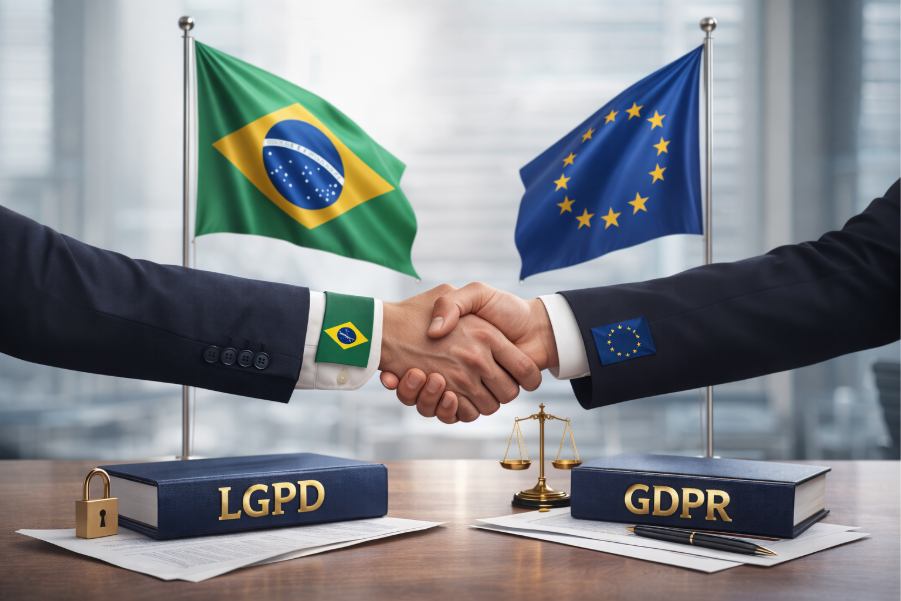
Milestone Celebrated on International Data Protection Day
The adequacy decision occurs when an authority recognizes that another country offers a level of personal data protection considered equivalent to its own legal standard. In this case:
- The European Commission has stated that Brazil ensures a level of data protection equivalent to that established by the EU's General Data Protection Regulation (GDPR).
- Brazil's National Data Protection Agency (ANPD), in turn, acknowledged that European Union countries offer protection comparable to Brazil's General Data Protection Law (LGPD).
This mutually recognized equivalence generates a regime of mutual adaptation, something unprecedented on a bilateral scale between Brazil and an economic bloc as large as the EU.
This decision symbolized progress in promoting globalization, highlighting the recognition of data protection as a fundamental right and strengthening trust between jurisdictions, paving the way for more harmonized models of international cooperation and a shared commitment to consistent data protection standards.
Therefore, the decision was a major milestone to be celebrated on International Data Protection Day in 2026, showing that data protection can be a bridge and not a barrier between countries in the 21st century.
What changes in practice?
- Simpler and more secure international data transmission:
Prior to mutual compliance, companies needed to implement additional mechanisms, such as standard contractual clauses, audits, or regulatory authorizations to transfer data between Brazil and the EU.
With mutual compliance, international transfers of personal data between the two regions can occur without additional bureaucratic steps, there is immediate legal security for companies operating on these borders, and the rights of data subjects are maintained and monitored in an equivalent manner on both sides.
In practice, a Brazilian company that uses European servers to store customer data no longer needs to worry about complex contractual clauses, as the data flow is automatically authorized due to compliance, for example.
- More integrated cyber products and digital services:
Digital products and services that collect and process user data can operate more efficiently between Brazil and Europe, such as streaming platforms and social networks, banking services and fintechs with international operations, applications with European cloud processing, and Brazilian user bases.
This interoperability should accelerate innovation and service offerings while guaranteeing user protection.

- Cost reduction for companies:
By eliminating extra regulatory steps, compliance costs and time are significantly reduced, innovation projects are accelerated, and small and medium-sized enterprises are able to compete more effectively in international markets.
In practice, a Brazilian tech startup that previously needed to make expensive contractual adjustments to operate in the EU can now scale operations with lower costs and fewer barriers, and vice versa.
- Strengthening research and scientific cooperation:
The adequacy agreement has an impact beyond business; it also facilitates collaborative international research projects in areas such as public health, data science and artificial intelligence, and global digital infrastructure.
This can boost cooperative science and technology programs that rely on the secure flow of data.
- Dynamic digital economy and increased trust:
With reduced regulatory barriers, digital trade between Brazil and the EU is expected to intensify, attracting investment and strengthening international competitiveness, especially in sectors such as fintech, healthtech, and data economy platforms.
The European Union is one of Brazil's largest economic partners, and this decision will undoubtedly facilitate financial development and strengthen relations between them, considering the high demand for businesses involving the sharing of personal data.
Economic development also serves as an incentive for other countries, which then seek to ensure regulatory compatibility as a means of reducing economic, legal, and geopolitical barriers.

Furthermore, it aims to reinforce Brazil's role in the global data protection agenda and demonstrate that high regulatory standards can be compatible with sustainable economic and digital development.
Conclusion
The mutual adequacy of data protection between Brazil and the European Union is a historic step forward, but without effectiveness if companies do not comply with data protection standards internally; the decision is collective, but the role is individual.
The adequacy decision is a regulatory facilitation mechanism between countries, but it does not replace the obligation of companies to comply with the LGPD (Brazilian General Data Protection Law) and the GDPR (General Data Protection Regulation). Business partners continue to require audits and due diligence to ensure the compliance of data operators.
Therefore, Ecomply is the key partner to assist in adapting any size and segment of business, as it brings innovations to the system with each advancement in the global data protection landscape.
Besides providing an easily accessible document containing standard contractual clauses for use in contracts with countries that have not yet reached a mutual compliance agreement with Brazil, the platform can also identify transfers that do not require these extra bureaucratic procedures, simplifying the processes.
Try it today and stay ahead in your international and regulatory relations.
ECOMPLY is a GDPR compliance management software that assists in building and maintaining compliance documentation. Check out our website or contact us for more information.


